
Syringe Pump or Infusion Pump? A Buyer's Guide for Veterinary Clinics
Nov. 26, 2026
Quick answer: Choose a veterinary syringe pump when you need controlled delivery of small drug volumes, particularly at low flow rates or for weight-based dosing in small patients. A volumetric infusion pump is generally more practical for larger fluid volumes, continuous fluid replacement and routine fluid therapy in dogs, horses and livestock.
Before almost every pump order, we get the same question: "Do I need a syringe pump or an infusion pump?" People often treat the two names as interchangeable. They are not. The right choice depends on the prescribed infusion rate, total volume, patient size and clinical application. Many veterinary hospitals use both types for different procedures.
This guide is written for veterinarians, hospital purchasing staff and distributors. It covers what each pump is built to do, the numbers worth comparing, and what to confirm before an order leaves the factory.
The short version: what each pump is for
A syringe pump pushes a syringe plunger at a controlled speed.
It is built for small, precise volumes: sedation, anesthesia, analgesia, chemotherapy, and micro-infusion in tiny patients. The syringe itself becomes the fluid path, so there is no drip set to prime and very little dead volume.
A volumetric infusion pump drives fluid through a drip set with a peristaltic mechanism. It is built for volume: dehydration, shock, perioperative fluid replacement, transfusion and large animal work. It handles bigger bags and higher rates without needing a syringe change every hour.
One is a precision instrument. The other is a workhorse. Neither replaces the other properly.
When a syringe pump is the right call
Look at the infusion rates and volumes your clinic uses most often. If you regularly administer small drug volumes at low flow rates, particularly when precise weight-based dosing is required, a syringe pump is worth considering. Check the minimum flow rate for the syringe size you intend to use, as this can make a significant difference in small-patient applications.
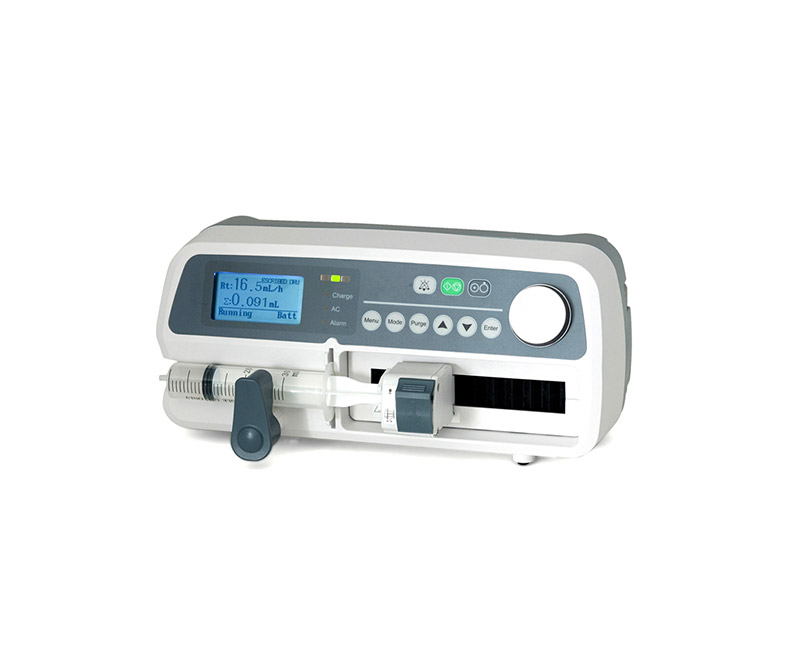
The IVT-250A is the model we point to for this job. It accepts standard 5-60 ml syringes from mainstream brands, so clinics are not locked into a proprietary consumable. Flow range depends on syringe size: 0.1-400 ml/h with a 10 ml syringe, up to 0.1-1300 ml/h with a 50/60 ml syringe. Infusion accuracy is ±2%, with mechanical accuracy at or below 1%.
It also does body weight dosing (mg/kg/min, mg/kg/h, µg/kg/h), holds a built-in drug library, and records system events. Automatic syringe identification and anti-bolus protection reduce setup errors, which matters when a 3 kg cat is on a vasoactive drug. Battery life is about 7 hours at 5 ml/h. The pump runs on standard syringes, and up to four or six units can be docked on one power supply. Full specification.
For exotics and neonates, ask specifically about the low end of the flow range. That is where most cheap pumps fail.
When a volumetric pump is the right call
If your day is dominated by fluid bags, a syringe pump makes staff change syringes constantly. A volumetric pump avoids that.
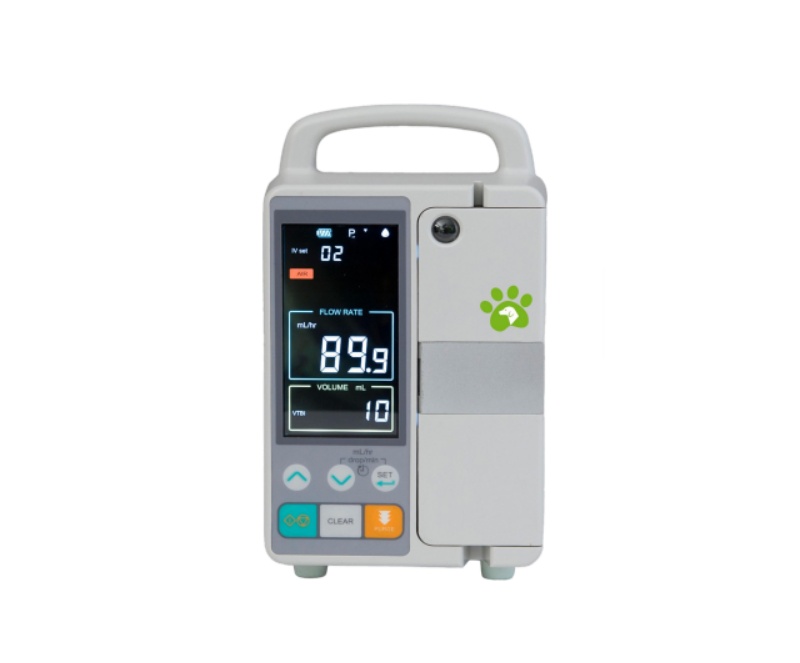
The IVT-200 series comes in three configurations. The 200A is a basic button unit, 1-1100 ml/h. The 200B adds adjustable KVO, a key lock and time-based infusion, 0.1-1500 ml/h. The 200E is the touchscreen version: 0.10-2000.00 ml/h, six infusion modes, a drug library, dual CPU, 50,000 records and optional Wi-Fi. All three use ultrasonic air bubble detection and adjustable occlusion alarms. The A and B have a built-in 30-45°C heater; the E supports an optional external heating strip. Battery life is around 5 hours at 30 ml/h for A and B, and 12 hours at 25 ml/h for the E. The 200E is rated IP44; the A and B are not,useful in busy prep or ICU areas where splashes and wipe-downs happen daily. Compare all three models.
Ask which accuracy figure applies to the exact model you are buying. Across this series it ranges from ±3% to ±5%, and a sales sheet that quotes one number for the whole family is worth double-checking.
Side by side
Syringe pump (IVT-250A) | Volumetric pump (IVT-200 series) | |
Best for | Drugs, anesthesia, analgesia, oncology, neonates | Fluid replacement, transfusion, large animals |
Flow range | 0.1-1300 ml/h, depends on syringe | 1-1100 / 0.1-1500 / 0.1-2000 ml/h by model |
Accuracy | ±2% | ±3% to ±5% by model |
Consumable | Standard 5-60 ml syringes | Drip sets and fluid bags |
Body weight dosing | Yes | 200E only |
Drug library | Yes | 200E only |
Heating | No | Built-in on A/B, optional on E |
Weight | 2.5 kg | 1.6-2.5 kg |
Stackable | 4-in-1 or 6-in-1 docking | No |
Four questions to ask before you order
What is the lowest rate you actually need? If you treat cats or exotics, get the number in writing. Ask for the rate at the smallest syringe size you will use, not the maximum.
Which consumables are locked in? Confirm that standard syringes or standard drip sets work. A pump that needs a special brand becomes expensive after six months.
How long does the battery last at your typical rate? A figure quoted at 5 ml/h says little about a 200 ml/h fluid bag.
What happens when it breaks? Ask how long a spare parts shipment takes and whether the pump can be serviced locally.
For distributors, add a second list: voltage and plug type for the destination market, the device's applicable CE conformity documentation, the manufacturer's ISO 13485 certificate, minimum order quantity, OEM terms and the separate price list for consumables and spare parts. Veterinary registration rules differ by market, so confirm what the destination country requires before ordering a full container.
Short answers to common questions
Can one pump handle both drugs and fluids? Technically some can, but workflow suffers. A 5-litre fluid plan in a syringe pump means repeated syringe changes; a 2 ml drug dose in a volumetric pump loses precision. Clinics with mixed caseloads usually buy one of each.
Are veterinary pumps just human pumps with a new label? The hardware overlaps, but veterinary workflows add weight-based dosing, a wider patient range and heating for cold fluids. Check that the mode you need is actually present, especially body weight dosing.
Do I need heating? Fluid warming can be useful when administering substantial volumes of fluids, particularly in small patients, neonates and animals undergoing anesthesia. Maintaining an appropriate fluid temperature helps reduce the cooling effect of infused fluids. Check the actual temperature range and heating configuration before choosing a pump.
What does the warranty cover? On these pumps it is one year for the whole machine. Consumables and damage from improper operation are normally excluded; confirm spare part pricing after the warranty period.
The practical next step
Tell us the drugs and fluids you run most often, the smallest patient you treat, and how many bays you need to equip. We will suggest the configuration and the consumables that go with it.
Email: info@ivetwell.com | WhatsApp: +86 153 1177 2890 |
Setting up a full ICU or anesthesia bay? Read our companion guide:
Previous: None
Next: Veterinary Blood Pressure Monitors: Doppler vs Oscillometric, and How to Choose